

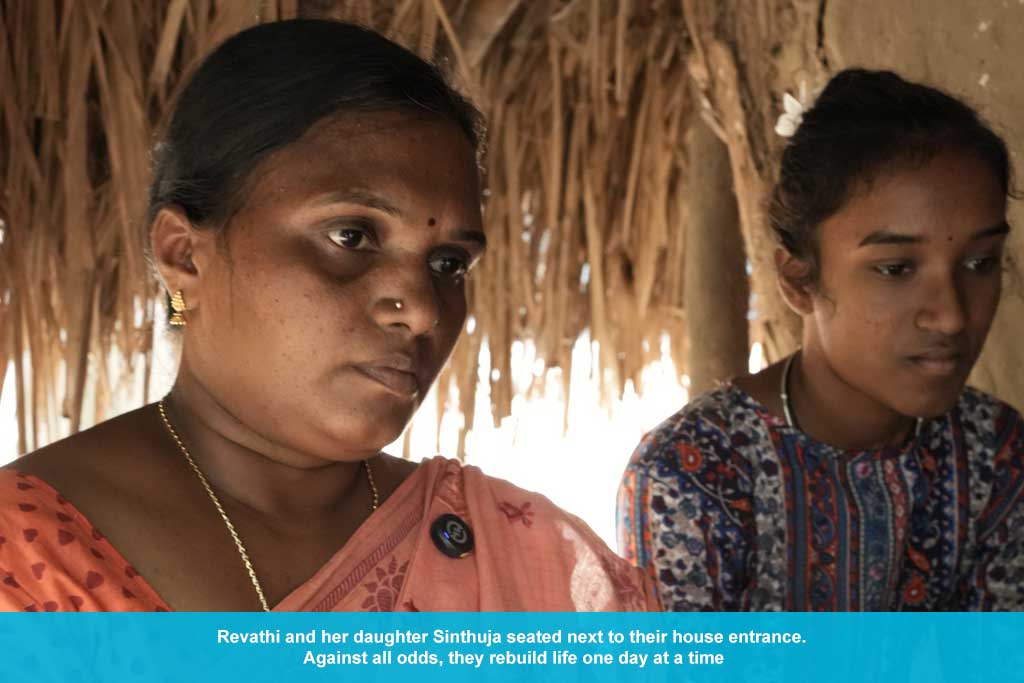
Revathi (40), an agricultural labourer from Iruvelpattu village in Villupuram district, Tamil Nadu lives with her three daughters Kamali (19), and Deepika (13). Following the passing of her husband a few years ago, Revathi has worked hard to provide for her family, earning about ₹130 a day.
On 2nd December 2024, Cyclone Fengal brought heavy floods to Tamil Nadu’s coastal belt, submerging Revathi’s home and sweeping away important belongings. “We lost our Aadhaar cards, my daughters’ schoolbooks, everything valuable,” she says. With their home under water, the family took shelter on a neighbour’s terrace, waiting for the water to recede.
In the face of these hardships, Revathi remained determined. “We couldn’t afford to go to school after that,” recalls her daughter Sinthuja. “So, my elder sister and I helped Mom with her work while our school provided uniforms and books, which really helped us keep going.”
Despite the emotional and physical toll, Revathi found new work within a month and continued doing her best to rebuild a sense of normalcy for her daughters.
Through Habitat for Humanity India’s Housing Disaster Resilience and Response (HDRR) programme, Emergency Shelter Kits (ESKs) were provided to 1,206 families like Revathi’s who were impacted by Cyclone Fengal. The kits were distributed to the families belonging to the Irular (commonly known as Irula) tribe and other marginalised communities residing in Koliyanur, Vikravandi, Thiruvennai Nallur, Kandamangalam and Kanai blocks of Villupuram district. Designed to offer immediate relief, the ESKs help families build temporary shelters or carry out basic repairs to their damaged homes, creating safe spaces until more permanent solutions can be put in place. Each kit consists of tarpaulin sheets, ropes, nails, a claw hammer, tie wire, pliers, a hoe, handle and plastic sheets. Habitat for Humanity India follows a ‘Pathways to Permanence’ approach of responding to disasters in a phased manner - beginning with immediate relief in the form of emergency shelter kits, followed by home repairs or transitional shelters and ultimately supporting families to build disaster-resilient permanent homes.
“With the kits we received, we were able to stay dry. The tarpaulin sheets gave us cover from the rain. The tools like the hand sickle and spade helped us drain water from around the house,” Revathi shares. Using the tools, they even created a small channel to divert floodwater away from their homes.
Revathi continues to rebuild her life, one step at a time, for the sake of her daughters’ future. With your help, she can provide her children with the stability and dignity they deserve.
You can support Revathi’s journey towards a safe, permanent home.
Donate now to make a difference.