

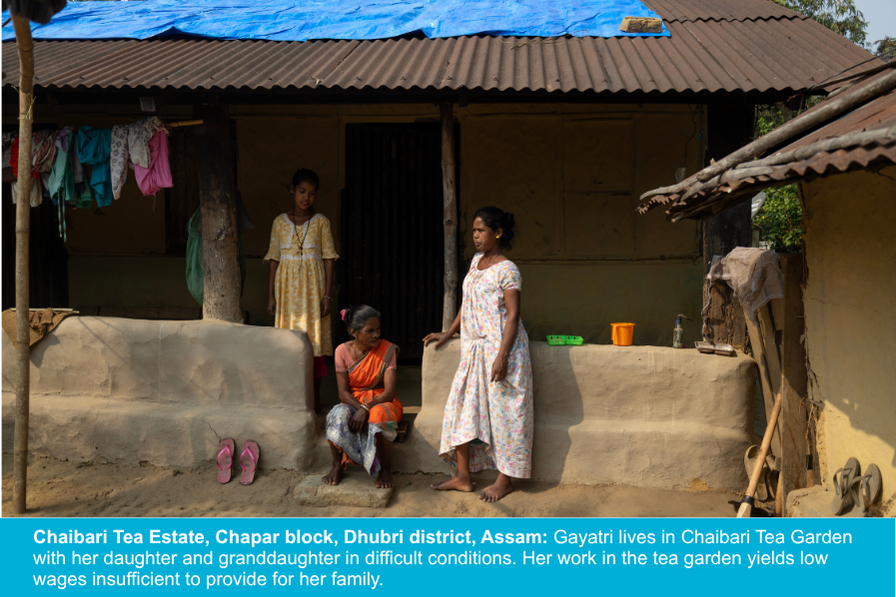
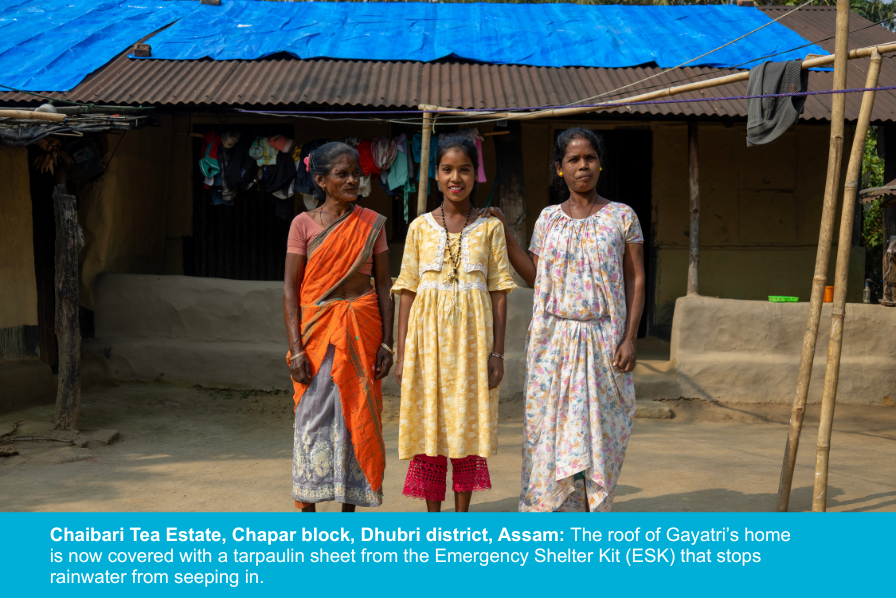
Gayatri, a 52-year-old tea worker, lives in Chaibari Tea Estate, Chapar block, in Assam’s Dhubri district. She shares a dilapidated home provided by the tea company with her daughter, Atowari and her 13-year-old granddaughter, Sono. As a member of the tea community — one of the most marginalised groups in Northeast India — Gayatri has endured a lifetime of poverty, hunger and lack of basic infrastructure.
Work at the tea garden has become increasingly scarce as the population in the estate area grows each year while the amount of work remains the same. This makes survival even more difficult for her family. Even when she finds work, she earns just ₹150 to ₹200 a day — barely enough to meet their basic needs.
Tragedy struck in 2006 when her husband, Ramesh, passed away from tuberculosis, leaving Gayatri to care for her family alone. Her meagre income prevented her from providing an education for her children and now, her granddaughter Sono has been forced to drop out of school due to a lack of funds for her education.
Gayatri's home has been in constant despair. The tin roof is damaged, allowing rainwater to seep in and soak their belongings. Strong winds frequently weaken the fragile walls, making the house unsafe. During the monsoon, sleepless nights are common as Gayatri struggles to keep her family dry.
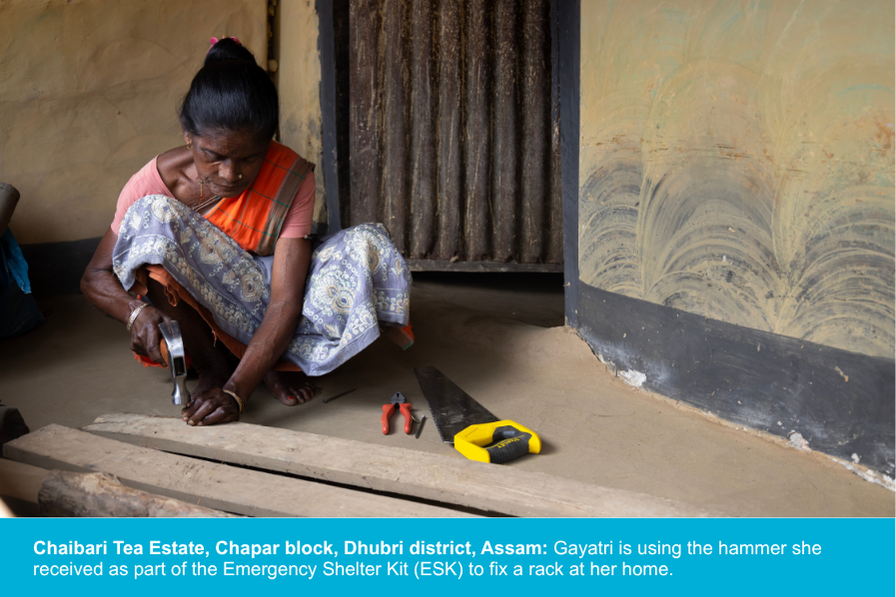
After Cyclone Remal, Habitat for Humanity India stepped in to support Gayatri and 99 other families in the tea garden by providing Emergency Shelter Kits (ESK) to the families affected by the disaster. The ESK has provided much-needed relief to her. Using the blue tarpaulin from the kit, she covered her leaking roof, finally shielding her family from the rain. The nails and tie wire helped her reinforce her home, making it more resistant to harsh weather.
Beyond just providing a safer shelter, the ESK has given Gayatri a renewed sense of security. She now uses the spade not only for household tasks but also for clearing drainage in the tea gardens during the off-season, ensuring a small but steady source of income.
"I have covered the roof with tarpaulin sheet which I got in the kit. I also used nails, tie wire and pliers from the kit to reinforce the weak walls of my home. My family is finally shielded from the rain,” says Gayatri with a smile of relief on her face.
As part of its Disaster Risk Reduction initiative, Habitat for Humanity India, has provided Emergency Shelter Kits to 329 families affected by Cyclone Remal in Dhubri and Barpeta districts of Assam. Each ESK consists of a tarpaulin sheet, covering sheet, hammer, spade, nails and washers, tie wire, rope, handsaw and a plier, helping them rebuild their homes and livelihoods.