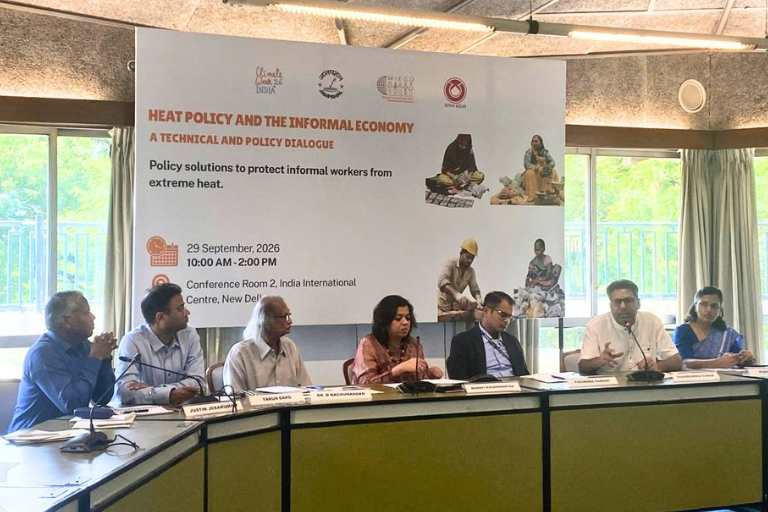
Sharing housing solutions for a cooler, more resilient tomorrow - a technical and policy dialogue at Climate Week India 2026
On 29 September 2026, Habitat for Humanity India participated in Heat Policy and the Informal Economy - A Technical and Policy Dialogue, organised by Women in Informal Employment: Globalising and Organising (WIEGO) in collaboration with Self-Employed Women's Association (SEWA) and Janpahal, as part of Climate Week India 2026.
The dialogue brought together researchers, practitioners, climate and urban experts, policymakers and representatives of informal workers to explore what more inclusive and effective responses to extreme heat could look like.
A key focus of the discussion was the growing recognition of extreme heat as a disaster and what this means for preparedness, worker protection, public health, urban planning and accountability. The conversation also highlighted the need to consider the realities of informal workers, particularly women, who may experience heat exposure across workplaces, homes and public spaces.
Bringing a housing perspective to heat resilience
Habitat for Humanity India contributed to the panel - Recognising Heat as a Disaster: What Would Change?, bringing the perspective of housing and disaster resilience to the discussion.
Habitat shared two experiences that demonstrate how practical, context-responsive housing solutions can contribute to climate resilience:
- Climate-resilient affordable housing in Odisha
- Cool-roof interventions in Tamil Nadu
Habitat India built 3 climate-resilient affordable homes in Odisha as a pilot, aiming to mainstream climate resilience in affordable housing through example. The three homes received India Green Building Council’s NEST Gold certification and incorporate measures designed to strengthen resilience while improving resource efficiency, including thermal insulation, solar energy, rainwater harvesting and other green building features.
Why housing matters in the heat conversation
For people living and working in vulnerable conditions, heat does not stop when the working day ends. The design and condition of a home can influence how safely people are able to cope with extreme temperatures.
This makes housing an important part of a wider heat-resilience response alongside public health, worker protection, disaster preparedness and urban planning.
The dialogue reinforced the importance of connecting policy with lived realities and of developing solutions that are affordable, evidence-based and responsive to local needs.
Through its work on climate-resilient housing, Habitat for Humanity India continues to explore how homes and communities can be better prepared for a changing climate - helping advance the goal of a world where everyone has a decent place to live.