

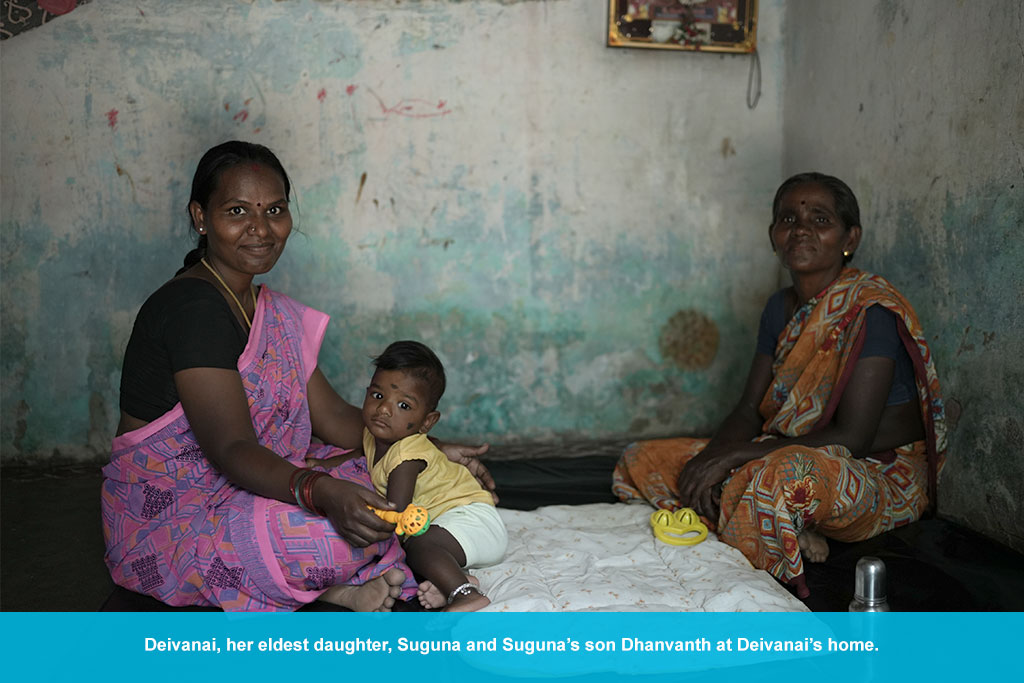
Deivanai, 50, lives in Vembi village located in Villupuram district, Tamil Nadu, with her children and grandson. A widow and a mother of six, she has spent most of her life shouldering responsibility with quiet strength. While three of her children are now married, the others still live with her and depend on her support.
“Raising six children alone and arranging their marriages has been really challenging,” Deivanai says. Her responsibilities grew further when her eldest daughter, Suguna, returned home with her newborn son, Dhanvanth. “My daughter started living with me during the delivery of my grandson. But she didn’t return since the house where her husband and in-laws lived was also dilapidated and wasn't safe for the baby. Now, I also look after my grandson,” she shares.
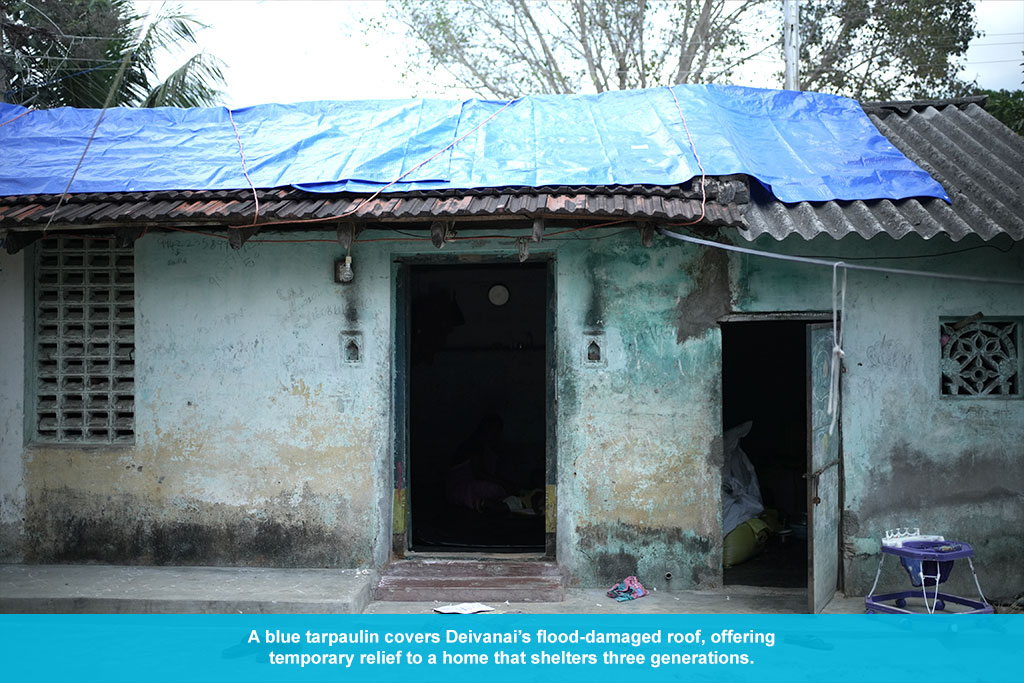
For nearly 30 years, Deivanai’s family lived in a house that struggled to withstand the rain. “Each time it rains, the water seeps in. The floors are soaked and it takes a toll on all of us,” she says. Still, they clean up and carry on.
In December 2024, when Cyclone Fengal caused severe flooding across Tamil Nadu’s coastal belt, Deivanai’s home was submerged. “We had to sleep on the wet floor,” she recalls. “Almost everyone in the house fell sick with cold and fever after the disaster. With no work available during this period, meeting daily needs became even more difficult,” she adds.
Through Habitat for Humanity India’s Housing Disaster Resilience and Response (HDRR) programme, Emergency Shelter Kits (ESKs) were provided to 1,206 families like Deivanai’s who were impacted by Cyclone Fengal. The kits were distributed to the families belonging to the Irular (commonly known as Irula) tribe and other marginalised communities residing in Koliyanur, Vikravandi, Thiruvennai Nallur, Kandamangalam and Kanai blocks of Villupuram district. Designed to offer immediate relief, the ESKs help families build temporary shelters or carry out basic repairs to their damaged homes, creating safe spaces until more permanent solutions can be put in place. Each kit consists of tarpaulin sheets, ropes, nails, a claw hammer, tie wire, pliers, a hoe, handle and plastic sheets. Habitat for Humanity India follows a ‘Pathways to Permanence’ approach of responding to disasters in a phased manner - beginning with immediate relief in the form of emergency shelter kits, followed by home repairs or transitional shelters and ultimately supporting families to build disaster-resilient permanent homes.
“The tarpaulin sheets helped cover our roof and keep the rain out,” says Deivanai. “The hammer and other tools helped me make small repairs and prepare for the next time it floods.”
Deivanai earns between ₹5,000 to ₹10,000 a month through agricultural work and small jobs. It is just enough to cover daily expenses for her large family. “I dream of a permanent home — one that does not flood and keeps us safe,” she says.
Her story is one of perseverance. With support, she is holding on to hope for a stronger, safer future for her children and grandson.
You can help Deivanai move closer to that dream. Donate today and support Habitat for Humanity India’s work in building homes that offer dignity, safety and peace of mind.